

Five years of the ECB Survey of Monetary Analysts: evolution and insights
Prepared by Felix Hammermann and Martin Strukat
1 Introduction
The European Central Bank’s (ECB’s) Survey of Monetary Analysts (SMA) is a valuable information set for monitoring the expectations of financial market participants regarding monetary policy and the macroeconomic outlook in the euro area. Launched as a pilot in April 2019 and placed on a fully operational footing in June 2021, the SMA is conducted ahead of each monetary policy meeting of the Governing Council. It provides structured information on the views of a representative panel of financial market institutions.[1]
Over the past five years, the SMA has helped the ECB to understand how market participants interpret macroeconomic, financial and geopolitical developments. SMA information proved to be particularly valuable during the post‑pandemic surge in inflation and the subsequent disinflation phase. The systematic collection of forecasts for the economy, the ECB policy rate and the ECB balance sheet across horizons, together with questions on the likelihood of outcomes and qualitative risk assessments, has given the SMA a central role in analysing expectations to inform the regular monetary policy assessment. The questionnaire and the aggregate results of each round are published on the ECB’s website.
This article takes stock of how the SMA has evolved over the past five years and how it is used at the ECB. First, it documents the evolution of the survey panel and questionnaire. Second, it outlines the analytical use of SMA information, both for regular economic and policy analysis and from a more structural perspective in enhancing the understanding of expectation formation. Third, it evaluates forecasting performance, disagreement among respondents and dispersion of expectations for key macroeconomic variables.
2 Evolution of the SMA panel
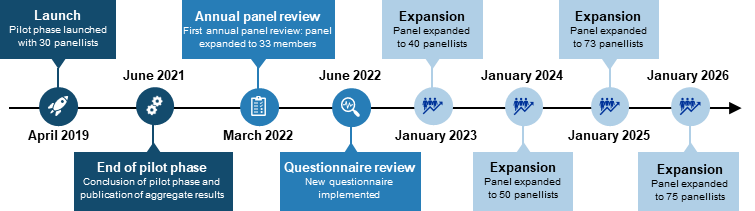
The SMA panel is designed to capture the expectations of a representative sample of financial market participants. Through the SMA, the ECB gathers market perspectives in a systematic way that is similar to surveys conducted by other major central banks, such as the Bank of Canada, the Bank of England and the Federal Reserve Bank of New York. Building on the initial survey framework, subsequent refinements have focused on strengthening representativeness, maintaining respondent engagement and enhancing the robustness of survey-based insights. Figure 1 summarises the development milestones since the launch of the survey.
Figure 1
SMA timeline
Source: ECB.
Note: The new panel becomes active in the January of the year following the panel review.
Ensuring that the panel remains representative of the views of financial market participants is central to the design of the SMA. In practice, this involves selecting a representative sample from a broad set of financial institutions based on established criteria that capture their market relevance and active engagement in areas covered by the survey while maintaining sufficient continuity to permit comparability across survey rounds.
Maintaining high and regular participation of respondents is essential for the reliability of survey results. As a core governance mechanism, the annual panel review monitors participation and response behaviour to facilitate appropriate adjustments to the panel composition. As shown in Chart 1 (panel a), the response rate (share of panellists participating in individual rounds) and the survey completeness rate (proportion of questions answered by respondents) have reached consistently high levels: both were around 90% in 2025, compared with 85% and 76% respectively in 2021.[2]
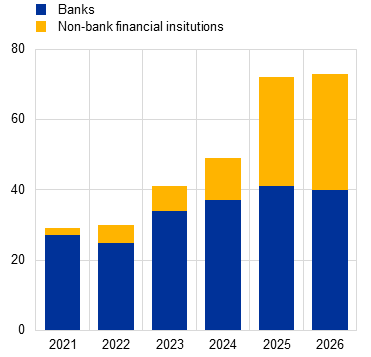
The size of the panel contributes to the statistical robustness and analytical value of the survey. The number of panellists has increased from 30 in 2021 to 75 in 2026 (Chart 1, panel b). As the panel becomes larger, the relative influence of individual responses decreases, improving the accuracy of aggregate statistics. A larger sample also enhances the analysis of cross-sectional heterogeneity, including disagreement among respondents and differences across types of institution.
Chart 1
SMA panel performance and evolution
a) SMA panel performance |
b) SMA panel evolution |
|---|---|
(annual average percentages) |
(number of panellists) |
 |
 |
Sources: SMA and ECB calculations.
Notes: Panel a): The response rate is the share of invited respondents participating in a given survey round, while the completeness rate is the proportion of questions answered by participating respondents. The response rate and completeness rate are calculated retrospectively for each year by first averaging across respondents within each survey round and then across rounds. Panel b): The annual panel review takes place between September and December, with the new panel composition taking effect from the January of the following year.
The composition of the panel has gradually been broadened to better reflect the diversity of financial market participants. While banks formed the core of the initial panel, expanding the participation has strengthened representativeness. The greater coverage of non-bank financial institutions – such as asset managers (including those that are part of banks), insurance companies, pension funds and hedge funds – provides a more balanced cross-section of market perspectives. These institutions, which also play a central role in the transmission of monetary policy in the euro area, now account for 47% of panellists, while banks account for 53%.
The questionnaire has been refined to ensure greater clarity and consistency of responses. A comprehensive revision in June 2022 streamlined the wording of questions and simplified the visual layout, reducing ambiguity and the burden on respondents while preserving the overall structure of the survey. A key advantage of the ECB conducting its own survey of market analysts is that the questions are formulated from a monetary policy perspective.
These developments have strengthened the SMA as a reliable source of information on financial market expectations and ensured that it provides insights that complement similar surveys conducted by private data providers (Box 1). Private polls provide timely and flexible snapshots of near-term market views from a broad respondent base, while the SMA offers systematic and comprehensive information based on a representative panel of institutions that are central to the transmission of the ECB’s monetary policy.
Box 1
The SMA and private data provider polls: comparing panel composition and survey design
Prepared by Martin Strukat
The SMA and polls from private data providers serve complementary but methodologically distinct roles in gathering information on financial sector expectations regarding monetary policy and macroeconomic developments. Both Bloomberg and Thomson Reuters conduct regular polls of market participants ahead of Governing Council monetary policy meetings, and their results are widely used for analytical and benchmarking purposes. While the SMA and private polls share the objective of gauging the sentiment and expectations of market participants, they differ in three important respects: the timing of data collection, the scope of the questionnaire and the composition of the panel.
On timing, the SMA follows a fixed schedule aligned with the monetary policy meetings of the Governing Council, with the response period ending two weeks prior to each meeting and results published on the Monday following the meeting. By contrast, private polls are generally conducted one week before the meeting, and the results are released in the same week.
In terms of scope, the SMA questionnaire is distinguished by its breadth, standardisation and long-term analytical design, covering monetary policy instruments, financial conditions and the macroeconomic outlook in a coherent and consistent framework. Questions are formulated to ensure consistency and comparability across survey rounds and thereby enable tracking of expectation dynamics over time. Consequently, SMA data facilitate the study of the interplay between individual macroeconomic expectations and policy expectations. Private polls usually contain only a question on policy rate expectations, which is complemented by ad hoc questions on current topics and developments.
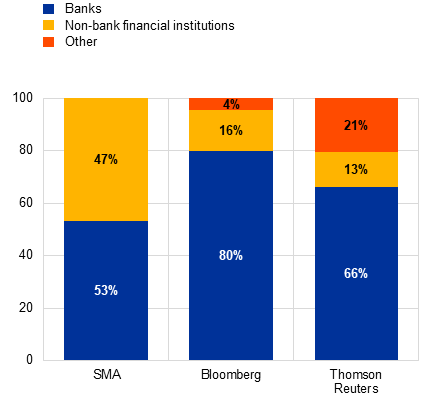
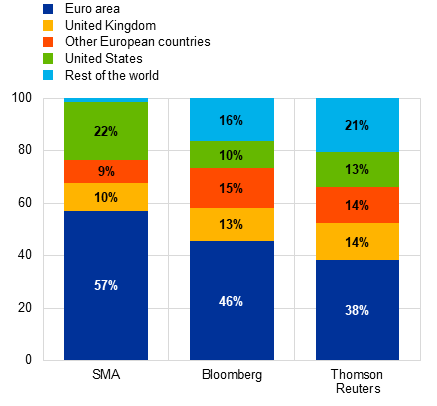
The composition of the SMA panel is specifically designed to capture the views of financial institutions active in the euro area, with a higher share of non-bank financial institutions than either of the private polls (Chart A, panel a). Banks constitute the largest group of respondents across all three surveys. However, in the Bloomberg and Thomson Reuters polls, non-bank financial institutions, on average, account for only 16% and 13% of respondents respectively, compared to 47% in the SMA. In contrast to the SMA, the two private polls also include brokers and research or advisory institutions under the category “Other”. In terms of geographical coverage, the SMA panel is more heavily concentrated on institutions headquartered in the euro area and Europe, complemented by a representative selection of global financial institutions (Chart A, panel b). This composition reflects the SMA’s deliberate focus on institutions with the most direct exposure to, and familiarity with, euro area monetary policy.
Chart A
Panel composition by type and geography
a) Panel composition by type |
b) Panel composition by geography |
|---|---|
(percentages) |
(percentages) |
 |
 |
Sources: Bloomberg, Thomson Reuters, ECB and ECB calculations.
Notes: The Bloomberg and Thomson Reuters columns reflect the average composition in 2025. Panel a): “Other” denotes research institutions and economic advisors or consultants. Panel b): “Other European countries” includes the Czech Republic, Denmark, Sweden, Liechtenstein, Norway and Switzerland.
3 What the SMA reveals about monetary policy expectations
The SMA gathers market perspectives to support monetary policy analysis, including via an understanding of expectation formation. The views of market participants matter because their expectations play a key role in the transmission of monetary policy. The SMA serves two main purposes. First, it provides an indication of the views of a representative sample of financial market participants on the economy and the monetary policy outlook, and this is used to inform the analytical work underpinning the preparation of Governing Council monetary policy meetings. The focus is typically on comparing the results with the previous survey round. Second, using multiple rounds, the SMA helps the ECB to analyse and identify systematic patterns in how financial market participants assess the development of the financial, macroeconomic and monetary policy environment and what drives revisions of their assessments. This perspective improves, at a more structural level, the understanding of expectations and the role they play in the transmission of monetary policy.
3.1 SMA-based insights into monetary policy expectations
SMA data provide valuable insights that serve as analytical inputs for the Governing Council’s monetary policy meetings. The focus of the first reading of incoming SMA data is on the median forecasts for interest rates and key macroeconomic variables. The evidence derived from the SMA complements information extracted from financial market instruments and serves as a valuable cross-check against Eurosystem/ECB staff macroeconomic projections. Material changes in the median relative to the previous survey round shed light on the shifting views of market participants on the economic outlook and monetary policy.
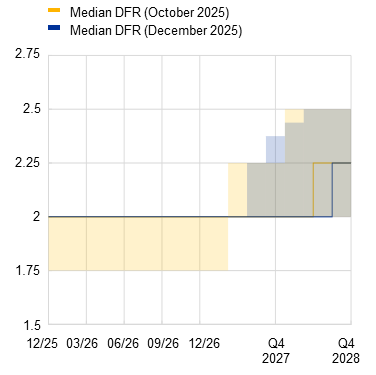
In addition, the distribution of expectations can provide important information beyond movements in the median. The December 2025 SMA is a useful example. While the median path for the expected deposit facility rate (DFR) remained broadly unchanged relative to the previous round in October 2025, the surrounding distribution narrowed (Chart 2, panel a). The interquartile range (between the 25th and 75th percentiles), which serves as a measure of disagreement, collapsed to the median in the short term, indicating a substantial reduction in disagreement among respondents. Taken together, the combination of a stable median and a narrowing distribution pointed to greater consensus on policy expectations, highlighting how measuring distribution can enrich the interpretation of aggregate statistics.
Chart 2
Evolution of DFR expectations
a) Median DFR expectations from consecutive SMA rounds in October and December 2025 |
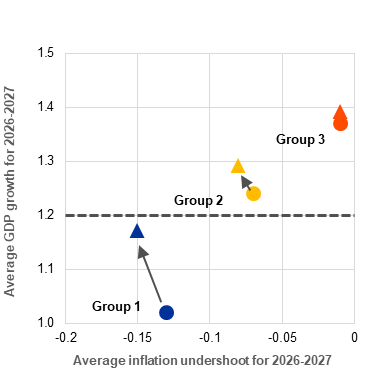
b) Expected deviation of inflation from target and expected GDP growth by evolution of DFR rate expectation between July and December 2025 |
|---|---|
(percentages per annum) |
(x-axis: percentage points; y-axis: percentages per annum) |
 |
 |
Sources: ECB and ECB calculations.
Notes: Panel a): Shaded areas indicate the interquartile range (the blue shaded area denotes the December round and the yellow shaded area the October round). The expected DFR path is given at Governing Council frequency until the end of 2026, and at quarterly frequency thereafter. Panel b): The coloured dots and triangles represent the positions in the July 2025 and December 2025 SMA rounds respectively for three groups of respondents: those anticipating cuts in the DFR in both rounds (Group 1, blue); those who anticipated cuts in the July 2025 round but not in the December 2025 round (Group 2, yellow); and those not anticipating rate cuts in either round (Group 3, red). The dashed grey line represents long-run average GDP growth.
To gain deeper insights into the underlying drivers of individual interest rate expectations, the December 2025 SMA can be compared with the July 2025 SMA round. Looking at the evolution of expectations over a longer period, such as half a year instead of just the previous survey round, can uncover changes in the views of market analysts. Although the aggregate results of the December 2025 SMA suggested a consensus regarding the path of the DFR, detailed analysis linking policy rate expectations to the economic forecasts of individual respondents revealed notable differences across three groups (Chart 2, panel b). Respondents who still anticipated a cut in the DFR over the forecast horizon (Group 1, blue markers) expected weaker inflation outcomes and subdued GDP growth prospects, despite their growth outlook having improved much more than for the other two groups. Respondents who did not expect rate cuts in December 2025 but had done so half a year earlier in July 2025 (Group 2, yellow markers) took an intermediate position: they maintained their slightly subdued inflation outlook while revising their growth outlook up a little. Finally, respondents maintaining expectations of no further rate cuts (Group 3, red markers) projected inflation broadly at target and growth well above the long-run average. Overall, these groups differed in their expectations for inflation, GDP growth and policy rates, highlighting how the SMA can uncover heterogeneity in macroeconomic assessments that shape policy expectations, even when aggregate indicators suggest a broadly stable outlook.
The joint behaviour of inflation, growth and policy rates embedded in SMA expectations can be benchmarked against simple policy reaction functions, such as Taylor rules, to assess whether market participants form expectations consistent with systematic monetary policy. Box 2 makes this comparison, showing that median expectations in the SMA interact in the direction that typical monetary policy rules would suggest – most notably, policy rate expectations rise with inflation expectations. However, the strength of this relationship varies over time, reflecting the size and nature of the shocks factored into survey expectations.
Box 2
What Taylor rules reveal about SMA-based monetary policy expectations
Prepared by Michael Dobrew and Martin Strukat
Taylor rules provide a simple and widely used framework for summarising stylised relationships between policy rates and macroeconomic conditions. In their standard formulation, they describe the level of the policy rate as a function of the deviation of inflation from its target and of economic activity from its potential, thereby encoding key trade-offs that central banks face (Taylor, 1993). In empirical work, such rules are often used as simple analytical benchmarks for examining how expected policy rate paths co-move with macroeconomic conditions.
Comparing policy expectations from SMA survey data with calibrated Taylor rules provides insights into how SMA respondents map their macroeconomic forecasts into policy rate expectations. Using a thick-modelling framework created by calibrating a range of Taylor rules as in Bernardini and Lin (2024), it is possible to derive a range of policy rate paths implied by the SMA median macroeconomic expectations and compare these with the SMA median expected rate path.[3] As shown in the example in Chart A (panel a) for the April 2024 SMA, the median expected DFR path can be compared with a range of rule-based predictions calibrated from the median expected paths for inflation and economic slack. This comparison offers a simple diagnostic of how expectations are formed: when the two are closely aligned, expectations are broadly consistent with a stylised, rule-like reaction function; when they diverge, expectations are likely to reflect additional considerations – such as risk assessments, views about the policy outlook or the interpretation of central bank communications – beyond what can be captured by a simple rule.
Chart A
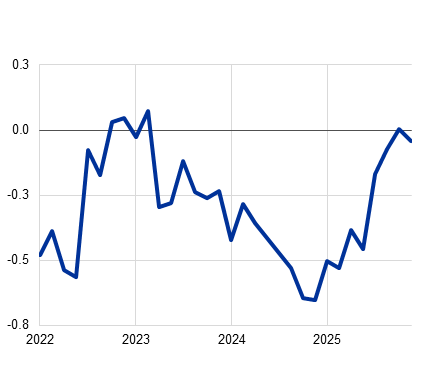
Taylor rule based policy rate path for April 2024 and deviation of SMA expectations from the contemporaneous rule-based policy rate over time
a) April 2024 rule-based rate path |
b) Deviation of SMA median from rule-based rate |
|---|---|
(percentages per annum) |
(percentage points) |
 |
 |
Sources: ECB and ECB calculations.
Notes: Panel a) shows the range of all calibrated implied Taylor rules together with the SMA median expectation for the April 2024 eight-quarter horizon. Panel b) shows the average deviation of the SMA median expectation from the rule-based rate over an eight-quarter horizon for each survey round from 2022 to the end of 2025.
In the past, SMA median policy rate expectations aligned closely with the Taylor rule implied rate paths based on SMA median macroeconomic expectations during the hiking phase, but pointed to a more accommodative policy trajectory during the subsequent cutting phase. For each survey round from 2022 to the end of 2025, Chart A (panel b) shows the average deviation of the SMA median expected rate from the rule-implied rate path over an eight-quarter horizon. In the tightening phase up to 2023, survey-based and rule-based expectations moved broadly in tandem, suggesting that market participants were broadly forming their policy rate expectations in a rule-like manner, consistent with the evolution of inflation and economic activity. From late 2023 to the middle of 2025, however, the SMA median policy rate fell below the median rate derived from the Taylor rule framework.
This gap points to expectations of a faster decline in policy rates than would be implied by the SMA median macroeconomic outlook alone. At that time, the disinflation process was slowing as inflation approached the ECB’s target, while expectations of inflation at horizons beyond one year had moved temporarily below target, and the balance of risks reported by SMA participants was tilted to the downside for both inflation and growth. These factors are likely to have contributed to market participants anticipating a rate path declining more steeply than a simple rule-based framework would suggest.
In the second half of 2025 in particular, market commentary increasingly referred to the possibility of a “rate reversal”, whereby policy rates were expected not only to return to levels consistent with the long-run rate implied by the survey (around 2%) but to move temporarily below that level, before eventually rising again. Some analysts characterised this pattern as involving “insurance cuts”, reflecting precautionary easing in response to downside risks to inflation and growth. These risks are not necessarily reflected in analysts’ forecasts of inflation and growth and are therefore not captured by the Taylor rule implied rate path.
Overall, SMA median, macroeconomic and policy expectations interact in the direction that typical monetary policy rules would suggest; in particular, policy rate expectations rise with inflation expectations. However, the strength of this relationship can vary over time, depending on the size and nature of shocks factored into survey expectations.
SMA data have also been used to investigate the drivers and determinants of expectations and their revisions across several survey rounds. Analytical work based on individual SMA responses shows that policy rate expectation errors and revisions of policy rate expectations can be linked both to changes in the macroeconomic outlook and to changes in SMA respondents’ perceptions of the ECB’s reaction function, i.e. how the ECB would respond in a given economic environment. In other words, the data allow a decomposition of expectation errors into components related to misperceptions of policy and evolving economic conditions (Akkaya, Bitter et al., 2024). More broadly, survey-based expectations provide a useful framework for assessing how incoming information and monetary policy communications are incorporated into expectations over time, including through their interaction with market sentiment and broader macroeconomic developments (Akkaya and Ilieva, 2024). Within this framework, joint analysis of the SMA and expectations extracted from financial market prices can help the ECB to align its communication with market participants by detecting and clarifying possible misperceptions of its reaction function.
Taken together, the decompositions of the expectation errors of individual respondents and the Taylor rules calibrated in Box 2 reveal that expectation formation in the SMA is largely determined by the macroeconomic environment. During calmer periods, signals from market prices and official ECB communications carry more weight, showing that, in general, the formation of SMA expectations is consistent with the ECB’s reaction function. However, when uncertainty prevails in the economy, as in periods of high volatility, it is difficult to forecast inflation and growth accurately, and this has repercussions for policy rate expectations. Against this background, we discuss next the forecast accuracy of SMA expectations.
3.2 Forecast accuracy, disagreement and perceived risks
Forecast accuracy, disagreement and perceived risk together provide a multidimensional picture of the expectation landscape that enhances the value of the SMA as a tool for monetary policy assessment. Forecast accuracy is a natural benchmark for the SMA: small and unbiased errors signal that participants process available information efficiently, lending credibility to their expectations as inputs to the policy assessment of the ECB alongside other sources, including the Eurosystem/ECB staff projections, additional surveys and market-based signals such as inflation fixing contracts. Beyond accuracy, the cross-sectional dispersion of point forecasts across respondents (a measure of disagreement) captures the degree of heterogeneity in views among informed market participants. Finally, the balance of risk assessments embedded in the SMA provides an insight into whether analysts perceive risks as broadly symmetric or tilted in a particular direction. Together, these three dimensions – forecast accuracy, disagreement and perceived risk – offer a richer and more granular characterisation of expectations than point estimates alone, providing the monetary policy assessment with a more complete map of the expectation landscape.
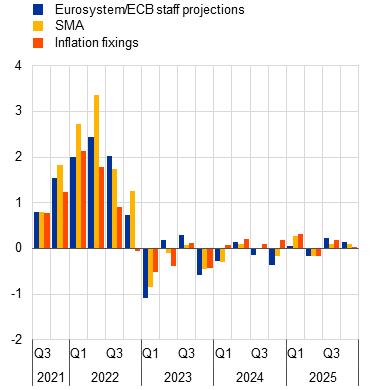
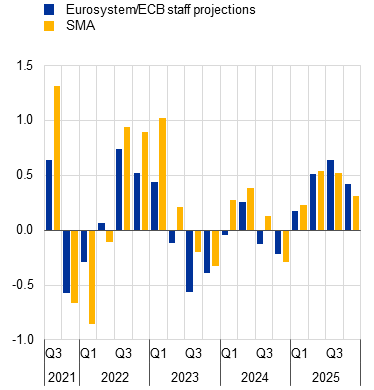
There were two clearly distinct phases in SMA inflation forecast errors that differ markedly in character, separated by a structural break around mid-2023. Regarding forecast accuracy for headline inflation over the review period from mid-2021 to the end of 2025, Chart 3 (panel a) shows one-quarter-ahead forecast errors. Two distinct phases emerge. Prior to the peak of inflation in mid-2023, the SMA median exhibited sizeable and mostly positive forecast errors. Eurosystem/ECB staff projections and inflation fixings recorded errors of a similar magnitude to the SMA, albeit with some variation across indicators and survey rounds. This failure in forecasting has been documented for institutional and survey-based forecasters alike (Chahad et al., 2023; IMF, 2023). For the forecast errors in the Eurosystem/ECB staff projections, Chahad et al. (2023) identified the unprecedented sequence of price shocks – from pandemic-related supply and demand mismatches and Russia’s invasion of Ukraine – as the primary driver.
During the subsequent normalisation phase, the picture changed markedly as forecast errors shrank substantially. With energy price pressures dissipating and inflation moving back towards target, forecast errors across all three indicators converged towards zero, reflecting an improvement in forecastability as macroeconomic conditions stabilised. During this period, SMA forecast errors were frequently marginally smaller in absolute terms than those of both Eurosystem/ECB staff projections and inflation fixings, suggesting that the aggregation of informed analyst judgement compares favourably with institutional projections and market-based signals under more normal conditions – a finding that is consistent with the broader evidence reviewed in ECB (2025). This pattern holds robustly across horizons, from the current quarter to four quarters ahead, as reported in Ploj (2025).
Chart 3
Comparison of SMA and Eurosystem/ECB staff projections forecast errors one quarter ahead
a) HICP inflation |
b) Real GDP growth |
|---|---|
(percentage points) |
(percentage points) |
 |
 |
Sources: SMA and ECB calculations.
Notes: Forecast errors are defined as the difference between the SMA median point forecast and the outturn. Positive (negative) errors indicate that the median underestimated (overestimated) actual inflation. Panel a): Inflation fixings are swap contracts tied to monthly releases of euro area HICP (all items excluding tobacco), available from the current month up to 23 months ahead.
For real GDP growth, the picture is more mixed (Chart 3, panel b). Both the SMA and Eurosystem/ECB staff projections recorded notable forecast errors around the pandemic shock and the subsequent rebound, with errors alternating in sign across survey rounds and neither indicator systematically outperforming the other over the full sample. This absence of a clear hierarchy in GDP forecast performance is not surprising given the inherent difficulty of anticipating turning points in real activity in real time, and it underscores the value of tracking the full distribution of SMA responses – including disagreement and perceived risk – rather than relying on point forecasts alone.
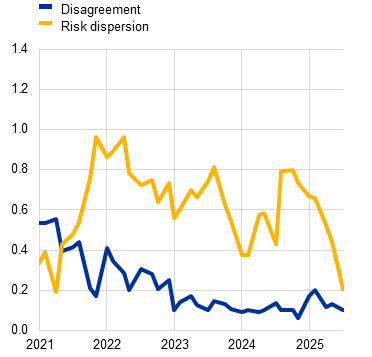
Beyond forecast accuracy, the informational advantage of the SMA lies in its capacity to characterise the full distribution of expectations across market participants, capturing not only where analysts expect the economy to go but also how much they disagree about it and whether perceived risks are tilted. To capture these dimensions, two complementary indicators can be derived from the survey: disagreement and risk dispersion. Disagreement is measured by the interquartile range of individual point forecasts, reflecting the cross-sectional spread of central expectations across respondents, while risk dispersion reflects the net balance of the share of respondents reporting upside and downside risks around their baseline, derived from the qualitative risk assessment question. Taken together, these indicators map onto distinct features of the implied distribution of expectations: disagreement captures its width, while risk dispersion captures the asymmetry of perceived tail risks around the central tendency.
Regarding inflation, disagreement and risk dispersion among SMA panellists increased markedly during the inflation surge and declined rapidly as the subsequent disinflation progressed. For HICP inflation, disagreement and risk dispersion peaked at around 1.2 and 1.0 percentage points respectively before falling back to low levels by mid-2023 (Chart 4, panel a). For GDP growth, disagreement gradually declined over the review period (Chart 4, panel b). By contrast, risk dispersion remained more elevated, indicating that, while baseline views have converged, differences in risk assessment persist.
Chart 4
SMA disagreement and risk dispersion for HICP inflation and real GDP growth
a) HICP inflation |
b) Real GDP growth |
|---|---|
(percentage points, percentages) |
(percentage points, percentages) |
 |
 |
Sources: SMA and ECB calculations.
Notes: Disagreement, measured as the width of the interquartile range, is shown for one-quarter-ahead expectations. Risk dispersion is based on annual expectations for the corresponding variable from the balance of risks question in the SMA. Risk dispersion is defined as the net balance between the share of respondents expecting upside risks and the share expecting downside risks.
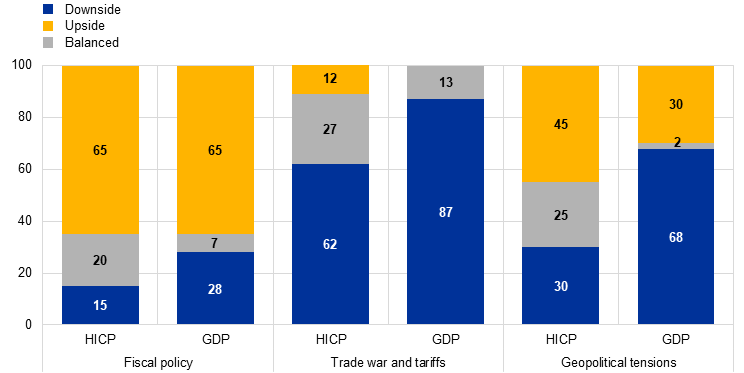
Finally, the indications of SMA participants regarding the risks to their macroeconomic forecasts are used to assess whether an economic shock has a greater effect on the supply side or the demand side. In the December 2025 SMA, after grouping the individual responses, the top three categories were “fiscal policy”, “trade war and tariffs” and “geopolitical tensions” (Chart 5). Regarding “fiscal policy”, many respondents referred to the German fiscal package and the announced increases in defence and infrastructure spending, so the shock was mostly seen as having a positive effect on demand, posing upside risks to both inflation and growth. “Trade war and tariffs” was clearly judged to be a downside risk to growth with mostly dampening effects on prices, qualifying as a potentially negative demand shock. “Geopolitical tensions” was also expected to have a largely negative effect on growth, but the implications for prices appeared to be less clear. These risks could materialise on either the demand or the supply side. The nature of risks surrounding the economic outlook matters, because monetary policy can more effectively accommodate demand shocks, whereas the monetary policy response to supply-side shocks tends to be less aggressive in order to limit any adverse impact on the economy.
Chart 5
Classification of risks in the December 2025 SMA
(percentages)
Sources: SMA and ECB calculations.
Notes: Percentages may not add up to 100% due to rounding. The latest observations are for December 2025.
4 Conclusion
Over its first five years of full operation, the SMA has developed into a core tool for monitoring and analysing the macroeconomic forecasts and monetary policy expectations of financial market participants. The systematic enlargement and rebalancing of the panel, together with refinements to the questionnaire and a structured governance framework, have strengthened the statistical underpinnings of the survey and improved its stability, coverage and representativeness.
SMA information is systematically used for monetary policy purposes, both in the preparation of Governing Council meetings and for addressing more structural policy questions. The survey provides a benchmark for prevailing market expectations, facilitates the assessment of how news and ECB communications are incorporated into views on the macroeconomic outlook and the policy path, and helps in analysing the formation, revision and dispersion of market participants’ expectations beyond market prices. The analysis in this article shows that SMA expectations are broadly consistent with macroeconomic fundamentals and simple policy benchmarks and, when viewed as a forecasting instrument, deliver an overall accuracy that is broadly comparable to Eurosystem/ECB staff projections.
References
Akkaya, Y., Bitter, L., Brand, C. and Sá, D. (2024), “Policy expectation errors during the recent tightening cycle – insights from the ECB’s Survey of Monetary Analysts”, Economic Bulletin, Issue 1, ECB.
Akkaya, Y. and Ilieva, B. (2024), “Decoding revisions in policy rate expectations: insights from the Survey of Monetary Analysts”, Economic Bulletin, Issue 7, ECB.
Bernardini, M. and Lin, A. (2024), “Out of the ELB: Expected ECB policy rates and the Taylor rule”, Economics Letters, Vol. 235, February.
Brand, C. and Hutchinson, J. (2021), “The ECB Survey of Monetary Analysts: an introduction”, Economic Bulletin, Issue 8, ECB.
Chahad, M., Hofmann-Drahonsky, A.-C., Page, A. and Tirpák, M. (2023), “An updated assessment of short-term inflation projections by Eurosystem and ECB staff”, Economic Bulletin, Issue 1, ECB.
European Central Bank (ECB) (2025), “A strategic view on the economic and inflation environment in the euro area”, Occasional Paper Series, No 371, June.
International Monetary Fund (IMF) (2023), World Economic Outlook: Navigating Global Divergences, Washington D.C., October.
Ploj, G. (2025), “SMA vs. ECB inflation forecasts: Which forecasts drive interest rate expectations in the euro area?”, Short economic and financial analyses, Banka Slovenije, October.
Taylor, J.B. (1993), “Discretion versus policy rules in practice”, Carnegie-Rochester Conference Series on Public Policy, Vol. 39, December, pp. 195-214.
Legal Disclaimer:
EIN Presswire provides this news content "as is" without warranty of any kind. We do not accept any responsibility or liability for the accuracy, content, images, videos, licenses, completeness, legality, or reliability of the information contained in this article. If you have any complaints or copyright issues related to this article, kindly contact the author above.
